How to Balance on Ice Skates: Tips to Improve
Wobbling on ice skates feels terrible, right? It sure does! Until you learn to balance, skating can feel really hard for beginners. In fact, even as you learn to skate a bit, developing excellent balance could still be one of your biggest challenges. But there are many ways in which you can improve balance.
To stay balanced on ice skates, your feet must be under your shoulders and your knees slightly bent. Maintaining this posture ensures that your ankles do not rock inwards or outwards and that you do not wobble.

But in addition to getting your posture right, there are other small alterations that could help you develop your balance. Read on to learn all about ways in which you could improve your balance on skates.
How to Balance on Ice Skates: Tips to improve
Keep your knees bent
Bending your knees is the quickest way to feel more balanced on the skates.
When you keep your knees locked, you put a lot more pressure on your ankles making them wobble. It is difficult to stay balanced in this posture for long and the falls could be pretty harsh.
To prevent that:
- Bend slightly in your knees
- Keep your knees behind your toes
Maintaining this position keeps your weight properly distributed.
Keep your feet under your shoulders
Many beginners make the mistake of spreading their feet wide when skating. The inverted V position does offer a bigger base to balance when stationary but when you start moving this position makes your ankles wabble and you run the risk of losing your balance.
Keep your feet under your shoulders. It also helps you balance when transfering your weight from one foot to other. If you keep your legs too wide you will have to shift a longer distance that could make your lose your balance.
Skating with your feet too narrow also reduces mobility as the edge of your foot gets locked.
Basically, you want to ensure that your ankles are not rocking when you skate. Your ankles should not be bending inward or outward at any cost.
Use your arms for balance
Using your arms while skating is crucial for balance.
- Spread your arms out slightly wider than your shoulders
- Place them at hip height
- Imagine you are placing them on a table in front of you
Initially, try and maintain this position while skating.
Once you feel a bit more confident, you can move your arms into different positions. But even then, having your arms wide open will help you stay balanced as opposed to hunching your shoulders and bringing your arms into your body.
March like a penguin and then glide
The basic technique of ice skating is very similar to marching penguins.
You will not be able to maintain your balance once you start marching, pushing or gliding if you don’t apply the penguin principles
- Bend your knees
- Keep your feet under your shoulders
- Spread your arms out
- Point your toes out
- Start marching one step at a time
Your marching should look similar to a penguin walk. Once you get comfortable with this, you can push longer and glide.
Pointing your toes is the most important. Without pointing your toes out, you will have trouble shifting weight from one leg to another.
Bend slightly forward
Many skaters tend to bend backward as they first start skating without support. But doing this puts the weight back on your hips and your hips push backward.
To maintain your balance, your body should be standing on your ankles and your feet should carry the weight of your body. Your back or your hips should not be burdened by it.
In addition to watching the position of your feet, knees, and arms, if you find yourself falling flat on your hips, check if you are bending backward or standing too upright.
Bend slightly forward when skating but keep your torse wide and open.
Additional tips to improve your balance when skating
Wear the right size of ice skates
Many skaters don’t realize that their inability to balance originates from them wearing wrongly sized skates.
Skates should
- fit snug
- give ample ankle support
- should be sized in such a way that the toe doesn’t touch the end of the skate
The right size of skates is very often one size smaller than the usual shoe size.
But instead of following this principle as a rule of thumb, it is advisable to refer to the size chart of every brand.
If you wear skates that are too loose, you will not get enough ankle support making your ankles wobble and causing you to lose balance.
On the other hand, skates that are too tight, restrict free movement and circulation, making it difficult to stay steady on the blades.
If your posture is right and you are still unable to balance, check if your skates are properly sized.
Tie your laces properly
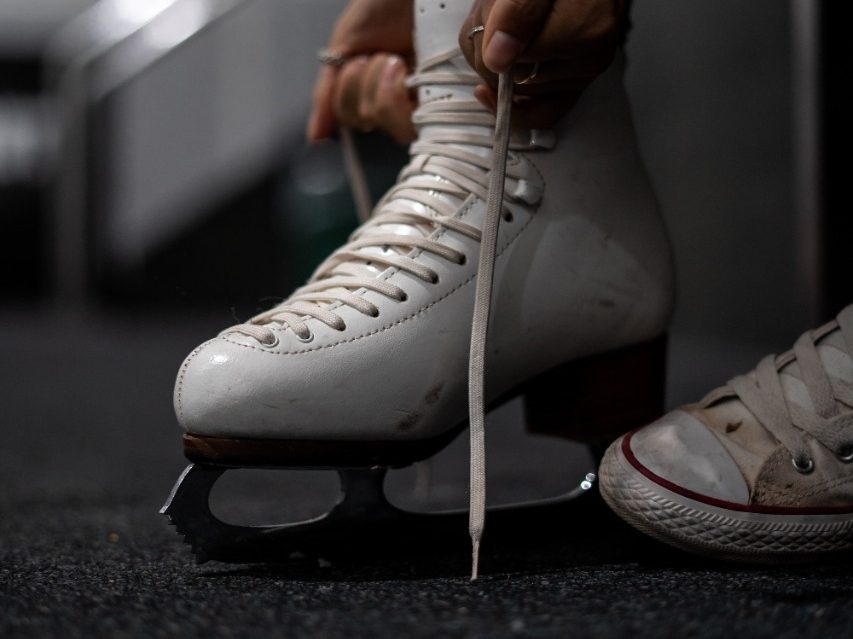
The next obvious check is how you tie your laces. Wearing the right sized skates is useless if you don’t secure your laces properly.
Your skates after lacing up should feel snug at the heel and the ankle.
The right way to lace up is
- Begin by loosening the laces completely
- Start tightening from the toe to the ankle by pulling the laces
- Tie the laces securely
If your laces are too long, you can wrap them around your ankle for extra support or tie them a couple of times extra over each other.
If you are wearing figure skates, make sure you pull your laces through the top holes as well.
Lacing up skates properly goes a long way in delivering optimal ankle support and should thus be done properly every time you skate.
Loose laces or laces that are too tight, just like wrongly-sized ice skates, can make you lose your balance.
Work on your core
Your core strength plays a huge role in helping you balance on skates.
Working on your core is one way of consistently improving your balance.
But the work needs to be done off ice. There are many ways in which you can improve your ice skating without being on the rink. You can read all about these ways here.
Exercises specific to core strength improvement are:
- Planks
- V abs
- Crunches
- Bridges
You can even do holds of various yoga postures to build core strength.
A classic Pilates roll-up is also excellent to tone your ab muscles and build core power.
Practice using a Bosu Ball
Stabilizing the core and getting used to holding your body upright on one leg requires a lot of muscle conditioning.
The best way to do it off-ice is by using a bosu ball.
A bosu ball is a semi-spherical ball i.e. it is shaped like a regular ball cut in half.
Practicing
- standing
- standing with one leg
- squatting
- dynamic leg lifts
can be immensely beneficial. You can even use the Bosu ball upside down (with the spherical part touching the floor) and practice the above exercise standing on the flat side for added difficulty.


Check out this Bosu Ball on Amazon
The video below is one of my personal favorite workouts as it specifically meets the balance requirements of skating
Wrapping up
Once we learn to push and move around a bit on ice skates, we tend to rush the process of learning new tricks and moves and do not pay attention to our basics. Neglecting basics is often the root cause of facing balance issues.
So my top recommendation to you would be to spend more than enough time getting your skating posture right. Make sure that every time you are on the rink, you are wearing the right skates, lacing them up properly, standing on your skates with your feet under your shoulders, and moving only after your posture is flawless.