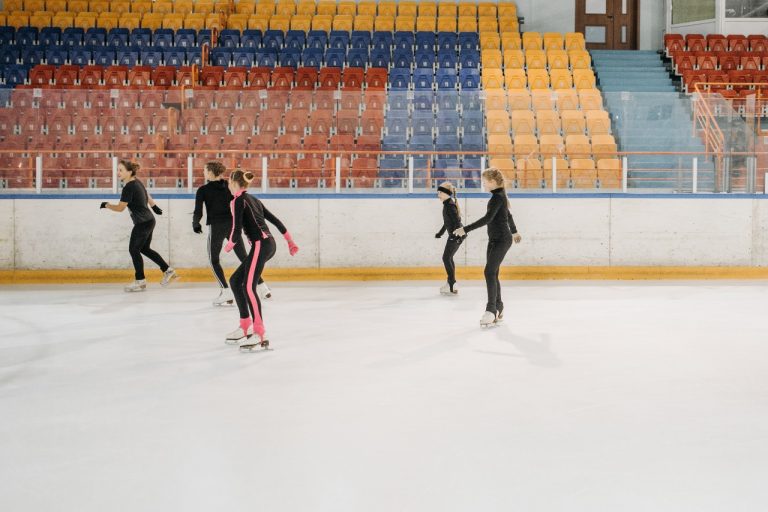
How often should you practice ice skating- Full Break-up
Figure skaters often wonder if they need to put in more hours to see faster progress. They also wonder how they should utilize their time on ice – if they should get in more public hours, add more lessons or get serious about off-ice work.
So in this post, I am going to tell you exactly how often you should practice ice skating. Most coaches recommend beginners and recreational skaters to skate at least twice a week for a minimum of one hour per session. More advanced skaters should skate at least 4 times a week with a focus on specific skills while those competing at pro levels should spend around 14-20 dedicated hours per week on ice.
But just getting these numbers is not going to help you make progress. What’s critical to understand is how to divide your time on ice between lessons and public sessions, what to focus on during your sessions and how to make changes to your schedule over time.
In this post, I am going to combine all of my knowledge, research and study on how often you should practice ice skating into a helpful guide.

How often should beginners practice ice skating
As stated earlier, most coaches recommend that beginners spend at least two hours on ice per week. But the amount of time spent will vary depending on whether the beginner takes classes or not.
A) For those who take group lessons-
The average duration of beginner classes is as follows:
- Beginners (tots) – 30 to 40 minutes – mostly once or twice a week
- Beginners (child) – 60 minutes – mostly once or twice a week
- Beginners (Adult) – 40-60 minutes – mostly once or twice a week
Beginners doing Basic Eight (Learn to Skate USA program) often spend up to 2 hours at the rink divided into on-ice and off-ice time.
But if you are doing only one lesson per week, it is recommended that you do an extra public session per week as per the schedule below.
Absolute beginners: 1-2 hours of public skating in addition to lessons. (Children under 5 whose parents don’t skate may avoid public skating as skating without proper guidance can develop incorrect technique.)
Recreational beginners: 2-3 hours of public skating in addition to lessons.

B) For those who don’t take any lessons-
As stated in my post on can you learn ice skating on your own, you can only learn the basic ice skating moves on your own. Any skill development beyond the basics needs expert supervision. Ideally it should come in the form of structured coaching that breaks down ice skating skills for you and make progress systematic.
But if you are
- still unsure if you should spend on lessons, or
- if you don’t know if you have time for dedicated lessons, or
- if you just want to learn the basics
you should be at the rink at least twice every week for a minimum of 45 minutes to one hour.
Even after you manage to learn the basics on your own, do not reduce your ice skating practice time. Any breaks to your ice skating routine will impact your progress.
To sum it up
| Type | Recommended lesson time per week | Recommended public sessions per week | Total time of ice skating practice recommended per week |
| Beginners taking classes (Tots) + with parents/friends/family with ice skating knowledge | 30 minutes | 1-2 hours | 1.5-2.5 hours |
| Beginners taking classes (Tots) + with parents/friends/family without ice skating knowledge | 30 minutes * 2 | 0 | 1 hour |
| Beginners (child) with with parents/friends/family with ice skating knowledge | 60 minutes * 1 or 30 minutes * 2 | 1-2 hours | 2-3 hours |
| Beginners (Adult) | 60 minutes * 1 or 60 minutes * 2 | 1-2 hours | 2-4 hours |
| Beginners doing Basic Eight | 120 minutes * 1 or 120 minutes * 2 | 1-2 hours | 3-6 hours |
| Beginners not taking any lessons | – | 1-2 hours | 1-2 hours |
Again, these are rough estimates. You should not take these as a standard.
It is best to consult your coach about how much time you should spend on ice based on your specific goals and skill level.
How often should competitive skaters practice ice skating

Unlike beginner skaters, it is very difficult to specify a number for how long competitive skaters should practice ice skating.
The number of hours spent in lessons and public sessions depend entirely on your skill level, the level that you are competing at and the specific challenges that you wish to overcome.
Most competitive skaters have lessons at least five days a week for about 1.5 to 2 hours.
This means that competitive skaters spend about 7.5 to 10 hours per week on lessons. In addition to this, coaches recommend at least 3-5 hours of practice session focused on specific skills.
It is best to discuss with your coach and design a competition strategy that works best for you.
Additional Tips to get the best from your time on ice
Learn from an expert and practice on your own
Many ice skaters make the mistake of trying to learn a new skill on their own before it is taught in group lessons.
Do not make this mistake as this can lead to development of technical errors that take a long time to correct.
Always learn from the coach or an expert. The lessons imparted by a coach are designed in way that makes breaking down the move easy and leads into development of a flawless technique.
Once your coach confirms that you have learnt the move properly, practice it repeatedly on your own in public hours.
Always structure your practice time in advance
Never enter a rink without knowing exactly how you plan to spend time on it.
Maintain a practice journal where you evaluate your skills and plan your practice sessions according to it.
Spending time on the rink without an agenda will not only be a waste of your time and money but will also not result in any substantial improvement.
A commonly followed structure is as follows-
- Warm up (off-ice)
- Warm up moves (on-ice)
- Practicing specific skills – spins/jumps, etc (2-4 skills or sets lasting 10-15 minutes each)
- Off-ice stretch and cool down
Practice at less crowded hours
Avoid practicing at times when you know the rink is crowded to get the most out of your practice.
Constantly having to watch out for a collision with someone else can be a dampener.
As a general rule:
- avoid weekends
- avoid after-school hours
Early mornings before school, a random weekday evening or a late night rink session is usually the best.
You can even visit rinks during off-seasons for extra practice.
Maintain even gaps between practice sessions
Whether you are a beginner or an advanced level skater, the gap between two sessions should be even and should gradually reduce with progress. If you leave uneven or unusually long gaps between two sessions, you risk losing out on the progress made and will have to spend a few more hours getting back to form.
Important note for ice skating practice for toddlers/youth
- always make sure your toddler is wearing a helmet and other protective gear when practicing
- do not make the toddler practice to the point of fatigue. Remember to keep it light and fun at all times.
- do not force your toddler to practice if the toddler is not showing keenness towards ice skating. Take it easy and listen to your child.
Frequently Asked Questions – Ice skating Practice
How long do ice skaters practice per day?
Beginner ice skaters practice between 2-6 hours per week while advanced competitive skaters even practice up to 2-4 hours per day.
How long does it take to become a good skater?
The amount of time it takes to become a good skater depends on the age of the skater, his fitness level, number of practice hours per week, quality of lessons and inherent talent. Most kids who start young take at least 7-10 years of continuous practice to reach elite levels of skating.
Is skating once a week good?
Skating once a week is good to maintain your level of skating. To make consistent noticeable progress, skating at least 2-3 times a week is recommended.
Related articles
Off-ice practice: Tips and routines
How to improve balance on ice skates
Are adjustable skates good for beginners
Go back to main page